PRICING ARCHITECTURE THAT QUIETLY DESTROYS PROFIT MARGINS
This is the FIRST in a 3 PART STRATEGIC SERIES throughout FEBRUARY 2026, and a follow-up to my last post on Brazil’s Q1 2026 marketplace dynamics. If you missed it, check my profile. FOLLOW ME to ensure you do not miss the upcoming insights on the STRUCTURAL TRAPS shaping unit economics in the Brazilian digital landscape.
In the Brazilian digital ecosystem, DEATH ZONES are specific price ranges where policy triggers and logistics step functions can invert the P&L. This architecture makes a HIGHER TICKET LESS PROFITABLE than a lower one. For professional sellers, efficiency is no longer about volume. It is about avoiding discontinuities where R$ 0.01 in price can unlock R$ 10.00 or more of incremental cost.
In 2026, the divergence between TOP LINE GROWTH and BOTTOM LINE EXTRACTION created an environment where micro pricing errors destroy capital efficiency.
MERCADO LIVRE: THE R$ 79 LOGISTICS STEP FUNCTION
Mercado Livre remains the most margin-trap terrain because the platform’s free shipping logic changes sharply at R$ 79.00 for MERCADO ENVIOS (ME2) listings.
▪️ BELOW R$ 79.00: You are not structurally forced into subsidizing shipping in the default setup.
▪️ AT R$ 79.00: The listing typically flips into free shipping.
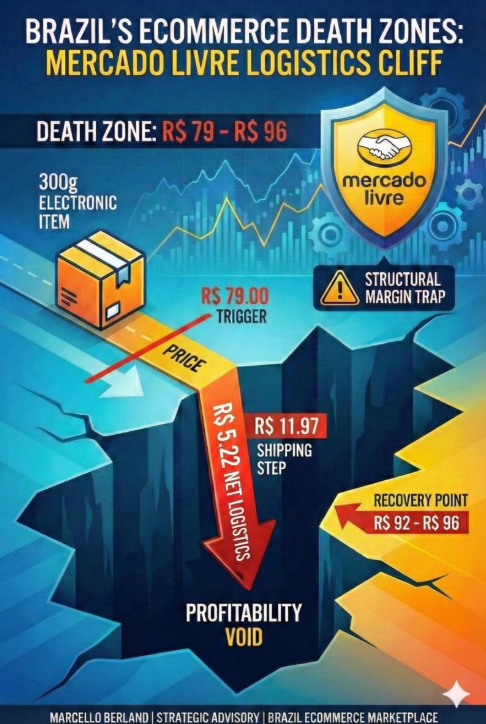
▪️ THE IMPACT: For a light package up to 300g in the R$ 79.00 TO R$ 99.99 band, the seller’s shipping contribution is approximately R$ 11.97.
The result is a CLIFF EFFECT. Moving from R$ 78.99 TO R$ 79.00 triggers a net logistics impact of R$ 5.22. While the shipping contribution is R$ 11.97, the removal of the R$ 6.75 fixed fee partially offsets the hit.
Under this methodology, covering this R$ 5.22 gap requires an additional price increase of R$ 13.00 TO R$ 17.00 once marketplace fees, taxes, ads, and inventory replacement costs (COGS) are factored in.
This pushes the RECOVERY POINT toward the R$ 92.00 TO R$ 96.00 range. Operating inside that gap is a STRUCTURAL MARGIN TRAP.
NEXT IN THE SERIES: WHY THE LOW TICKET DOMINANCE OF SHOPEE CREATES A DECEPTIVE MARGIN TRAP FOR PROFESSIONAL SELLERS.